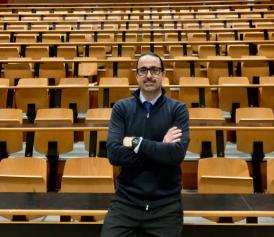
Pictured above: Pablo Iglesias-Rodríguez
Earlier this year, Rennes 2 University welcomed Pablo Iglesias-Rodríguez, Associate Professor in International Finance Law at the University of Sussex, as part of its International Chair in Humanities and Social Sciences programme. During his time in Rennes, he taught undergraduate students in Corporate Social Responsibility, contributed to a LiRIS seminar on stakeholder corporate governance, and pursued his research collaboration with Rennes 2 Professor Catherine Malecki. We spoke with him about his research, the importance of international academic cooperation, his experience at Rennes 2, and the joint projects that have continued beyond his stay.
Your work brings together international finance law, public policy and global governance. What originally drew you to international finance law and global governance issues?
When I was growing up in the 1990s, it was a time of financial turmoil and several major corporate scandals, some of them with global implications. This made me very curious from an early age about the financial system, how it affects people's lives, and what can be done to help guarantee that it works well. This is one of the reasons why, from my undergraduate studies through my PhD and into my current work, I have decided to focus on financial services regulation and on how law and policy can help protect financial stability, consumers, and investors.
What are some of the key challenges currently shaping this field? More personally, what aspects of these issues continue to motivate and inspire your research?
In recent years, two core areas have been drawing increasing attention among policymakers and scholars. One is sustainable finance. This is largely due to growing concerns about the impact of environmental and climate risks on the financial system. The other is decentralized finance, which has close links to technological developments such as digital tokens, artificial intelligence, and quantum computing that are transforming, and will continue to transform, the financial system and the way we interact with it. All of these developments raise important questions about how to adapt financial law and regulation to new challenges. I tackle these issues in my own research and policy work. My main interest is in how law and regulation can help keep the financial system stable and consumers and investors well protected.
International cooperation has played an important role throughout your career — both in research and teaching. In your view, what does working across different countries and academic cultures bring to scholarship and higher education?
I have learnt a lot from my academic visits abroad, and these experiences have influenced my own teaching. For instance, teaching in Poland, Italy, and Lithuania, to mention a few examples, exposed me to new teaching methodologies with which I was not very familiar, and I transferred the skills I gained through those visiting stays into my own teaching in the UK. Likewise, in my experience, students from other countries appreciate being exposed to teaching methodologies that may not be prominent in their own higher education systems, so I can also add value to the teaching and learning experience while visiting other academic institutions abroad.
In terms of research, I have developed collaborations with academics and practitioners from a number of countries, often on comparative issues where we each contribute perspectives from different jurisdictions. Many of these collaborations grew out of visiting appointments abroad. So, for me, international cooperation lies at the heart of my academic and professional work.
Your collaboration with Rennes 2 Professor Catherine Malecki played an important role in your visit. How did this collaboration develop, and where do you see it leading next?
Professor Malecki and I first met in March 2025 at a LiRIS seminar on Stakeholder Approach and Corporate Governance Evolution in Rennes. The seminar provided an excellent forum for discussing comparative aspects of stakeholderism in corporate governance. Since then, Professor Malecki and I have developed a collaboration that led to my application for the International Chair of Humanities and Social Sciences at Université Rennes 2.
Earlier this year, we had the great pleasure of hosting Professor Malecki at the University of Sussex as the External Examiner for a PhD dissertation on corporate law and governance; during her visit she also gave an excellent guest lecture on directors’ duties after the Omnibus I Simplification Package.
Looking ahead, our collaboration is continuing to develop. We are currently finalising work on an edited volume that will be published by Edward Elgar in early 2027, titled ‘Stakeholder Corporate Governance: New Perspectives, New Challenges’. We also have plans for further collaboration in, among other areas, joint PhD supervision and grant applications in our core area of shared interest which is corporate sustainability. Working with Professor Malecki is both a privilege and an honour. Her outstanding scholarship in corporate governance, corporate social responsibility, and corporate law has significantly influenced the field and continues to inspire my own research. I am very excited about all of these collaborative projects and look forward to working together on them.

From left to right: Catherine Malecki, Charlotte Villiers and Pablo Iglesias-Rodríguez.
What were your main teaching or research activities during your stay at Rennes 2? More broadly, how would you describe your experience and your exchanges with colleagues and students during your visit?
I was very lucky to be invited to teach a course on Corporate Social Responsibility for undergraduate students. The course was convened by Professor Roseline Mouchel, with whom I had the opportunity to have some great discussions on French approaches to corporate sustainability and the French idea of durabilité. The students were highly motivated and participative, and during my last teaching session we organised a debate on whether investments in defence can be sustainable. The debate was highly productive, insightful and engaging, with students putting forward different perspectives on this complex topic. It was an excellent way to conclude my teaching activities during the spring term.

Roseline Mouchel and Pablo Iglesias-Rodríguez (back, centre) with students at Rennes 2.
On 8 April 2026, I also participated in a LiRIS seminar on Stakeholder Corporate Governance alongside Professor Catherine Malecki, Professor Charlotte Villiers and Dr Anne Stevignon. I presented my recent research on ESG policymaking in the EU, which led to a fruitful discussion with the audience.
Beyond the academic dimension, what did you particularly appreciate or discover during your time in Rennes and at Rennes 2?
Living in Rennes is a unique experience. It is a wonderful and lively city with so many interesting sights to discover and enjoy (Marché des Lices, Thabor, the Musée des Beaux-Arts, to mention just a few). I would encourage everyone to visit Rennes and Brittany. As for Rennes 2, it has a beautiful campus and boasts a vibrant student community. All the people with whom I interacted were genuinely kind and always willing to help. This also contributed to making my stay truly memorable.
Finally, what advice would you give to students and young researchers interested in international law, European affairs or international academic careers?
Travel, learn from other places, and do not be afraid to move across countries for both your studies and your work. Be proactive and try to take advantage of all opportunities to advance your knowledge and skills in your chosen field. Most importantly, pursue research in an area that you genuinely enjoy.